
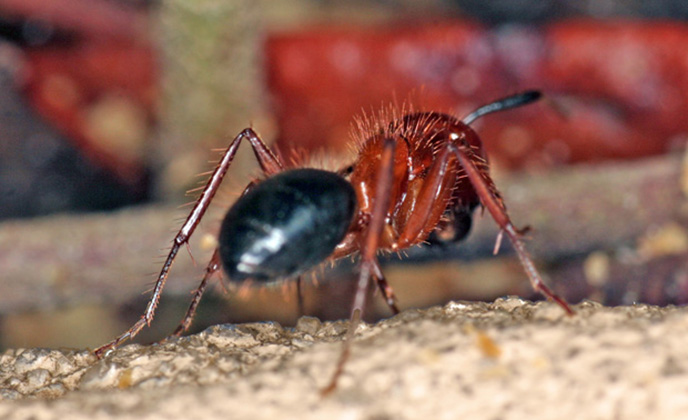
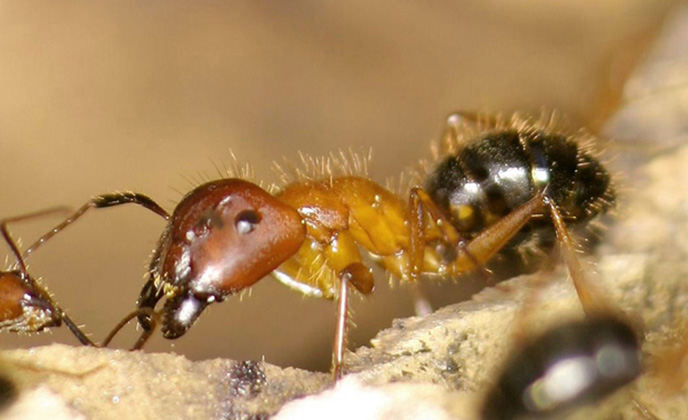
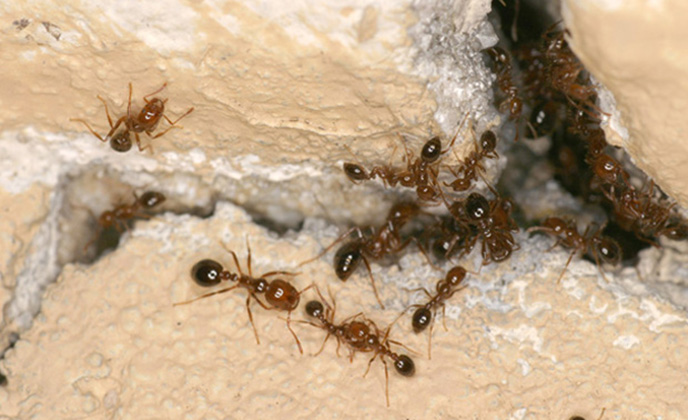
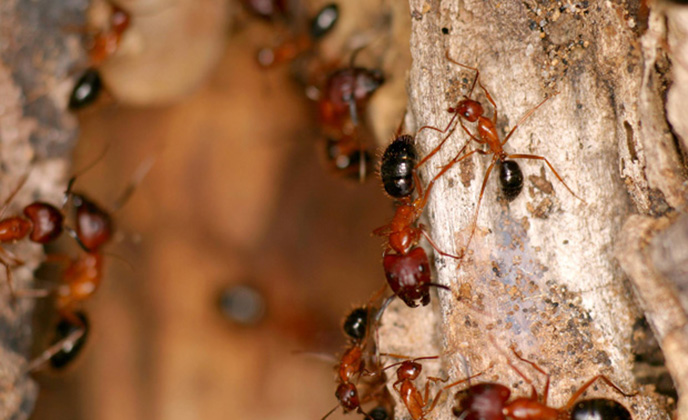
Carpenter ants get their name because they excavate wood to make nests. It’s a bit of a misnomer because carpenters make things from wood, whereas carpenter ants destroy wood, causing as much structural damage as termites. Sightings of large dark-colored ants inside your home usually points to the first sign of a carpenter ant infestation. However, on the bright side, this does not necessarily mean a carpenter ant nest is present indoors, as the location of a carpenter ant’s nest may actually be outside, near your home. Foraging workers generally enter homes in search of food and water. Worker ants, usually nocturnal, will forage in search of meats and sweet, fatty foods.
CARPENTER ANT FACTS
CARPENTER ANT BEHAVIOR
Drawn to moist wood under and around windows, roof eaves, decks and porches, carpenter ants tunnel through damp wood to the solid dry wood inside your home. Carpenter ants also tunnel outside constructing extensive underground tunnel systems, often leading to a food source. Outdoors, carpenter ants prefer to feed on the honeydew produced by aphids. Indoors, carpenter ants go for sugary, fatty foods in your kitchen.
Carpenter ants are foragers. Most species of carpenter ants forage at night, collecting and consuming dead insects. Workers surround dead insects, extract their bodily fluids and carry them back to the nest. Sometimes, carpenter ants bring the head of insects back to the nest, where they extract their inner tissues for food. Also, a few species of carpenter ants collect live insects. Worker carpenter ants forage individually or in groups, although they often opt to forage individually.
IDENTIFYING CARPENTER ANT NESTS
Homeowners can search for indoor nests using a flashlight to look for foraging workers at night. From May through July, between 10:00 PM and 2:00 AM, homeowners can check basements, attics, garages and their home’s exteriors, with the intention of following carpenter ants back to their nest or to discover where they are entering your home. Finding a number of winged reproductive ants at windows inside your house indicates you might have an indoor nest.
Indoor nests may originate from one or more parent colonies outdoors in a log, a hollow tree or moist lumber or another woodpile within 100 yards of your house. Worker ants travel regularly between the satellite and parent colonies. To eliminate carpenter ants, finding and removing the parent nest and all of the satellite nests is the key to the successful eradication of carpenter ants.
Indoors, porch pillars and supporting timbers, sills, joists, wall studs, window and door casings, and under insulation between ceiling joists or wall studs make common nesting areas.
DO CARPENTER ANTS BITE?
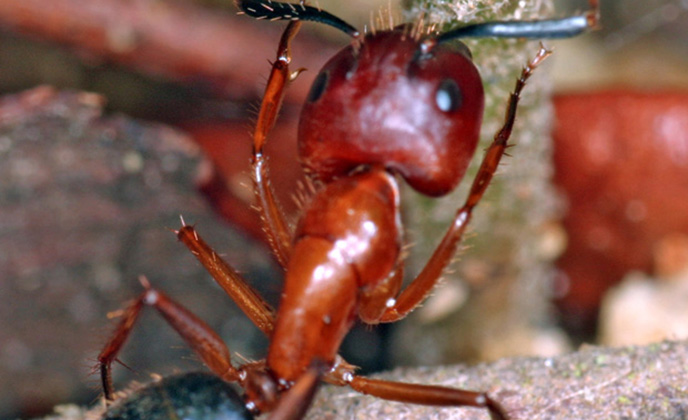
Carpenter ants will bite to defend their nests, if threatened. Because carpenter ants, like some other ants, build nests in hollowed out trees and woodpiles, humans sometimes accidentally encounter defensive carpenter ants, that use their woodcutting mandibles to bite and fend off intruders, when provoked.
Equipped with strong mandibles, bites by this relatively large ant species may break the skin, leaving sizable bite marks. Carpenter ant bites resemble pea-sized red blemishes. For sensitive individuals, bites might swell, becoming inflamed and may take just over a week to disappear completely. Carpenter ant bites feel like sharp pinches because they are and may be quite painful. The same acid found in bee stings, formic acid, might be injected into the wound during a bite, making the pain worse. The bite pain, felt immediately, is accompanied by a prolonged burning sensation if formic acid is involved. The good news is that although painful, carpenter ant bites do not contain venom or transmit diseases, therefore not posing any health threats to humans.
Immediately after experiencing carpenter ant bites, clean wounds with soap and warm water. Apply antibiotic ointment to a wound if the skin is broken. Bandage the wound after cleaning if desired. Avoid scratching wounds that may begin to itch for several days. Applying ice packs to wounds can help reduce itching.
GETTING RID OF CARPENTER ANTS
Because carpenter ant primary colonies may be indoors with several other satellite nests in moist or rotting wood outdoors, trying your hand at controlling carpenter ants can be tricky, as you will need to locate and eliminate the primary carpenter ant nest and all of the satellite ants’ nests. Primary colonies and satellite colonies must be eliminated or carpenter ants will reappear in a few days or weeks. To ensure all of the nests are eliminated, contact a professional pest control company. Truly Nolen’s certified and licensed technicians are trained in locating and eliminating all carpenter ant nests in and around your property.
Truly Nolen technicians, trained in locating carpenter ant trails, apply baits to the trails, reapplying as baits become depleted. With the application of scheduled outside perimeter treatments to your property, indoor monitoring and preventive bait placement, Truly Nolen’s Four Seasons approach to pest control can eliminate carpenter ants and other pests from your home with appropriate quarterly seasonal servicing.
REPAIRING DAMAGE CAUSED BY CARPENTER ANTS
Repairing structural damage and replacing damaged wood should happen at the same time the nests are removed. Satellite nests outside of the building should be eliminated by extracting the infested wood or tree or by treating it with an insecticide product only available through professional pest control companies.
CARPENTER ANTS VS TERMITES
Often confused with termites, carpenter ants do not actually eat wood but excavate it in order to carve out their nests, tunneling through moist or damp wood. The presence of sawdust indoors can be a telltale sign of a carpenter ant infestation.
For information on other ant species, visit our Ant Information page.
Click here to learn more about our Four Seasons Pest Control Service Program and how Truly Nolen of Charleston can help rid your home of troublesome carpenter ants.
When you sign up for 4 Seasons Pest Control, our quarterly pest control service.
Backed by over 85 years of experience from the national Truly Nolen brand, this franchise combines strong local expertise with proven pest management methods. Truly Nolen's roots go back to 1938, when Truly Wheatfield Nolen founded the company with a mission to treat customers like family while protecting homes through advanced, environmentally responsible solutions. Today, that philosophy continues to guide how we serve the Charleston area residents — prioritizing customized plans, ongoing education, and proactive prevention. For these reasons and more, we are Charleston's best pest control!
Pest pressures in Charleston aren’t the same as anywhere else. Coastal weather patterns can increase termite activity, while high humidity and heat contribute to mosquito breeding and ant infestations. The team at our pest control company in Charleston is trained to recognize seasonal pest trends and adapt treatment protocols accordingly. From targeted inspections to strategic prevention measures, our pest control services in Charleston, SC are equipped to deal with everything from carpenter ants and roaches to spiders, rodents, and more.
We know that no two properties are alike. That’s why our services are not “one-size-fits-all.” After a thorough property inspection, we design a plan that fits your family’s needs, your structural layout, and the specific pest pressures in your neighborhood. Whether you’re dealing with a current infestation or you’re looking to prevent pests before they become a problem, our Charleston-based pest control company provides personalized recommendations and professional advice on how to limit breeding areas, reduce attractants, and maintain a pest-free space.
Our commitment to pest control in Charleston, SC extends beyond homes to commercial properties. We provide integrated pest management services for retail shops, restaurants, office buildings, healthcare facilities, warehouses, schools, and more, ensuring that businesses can operate cleanly and safely without pests disrupting operations.
From food service establishments to industrial facilities, our commercial plans are tailored to meet industry-specific challenges. These plans combine preventive measures with corrective treatments, all backed by trained professionals who understand regulatory requirements and the importance of maintaining a pest-free environment.
At Truly Nolen of Charleston, we’re more than a pest control company in Charleston — we’re your neighbors. We proudly serve a wide range of communities in and around Charleston, including North Charleston, James Island, Folly Beach, Johns Island, Hollywood, Meggett, Ravenel, Wadmalaw Island, and beyond!
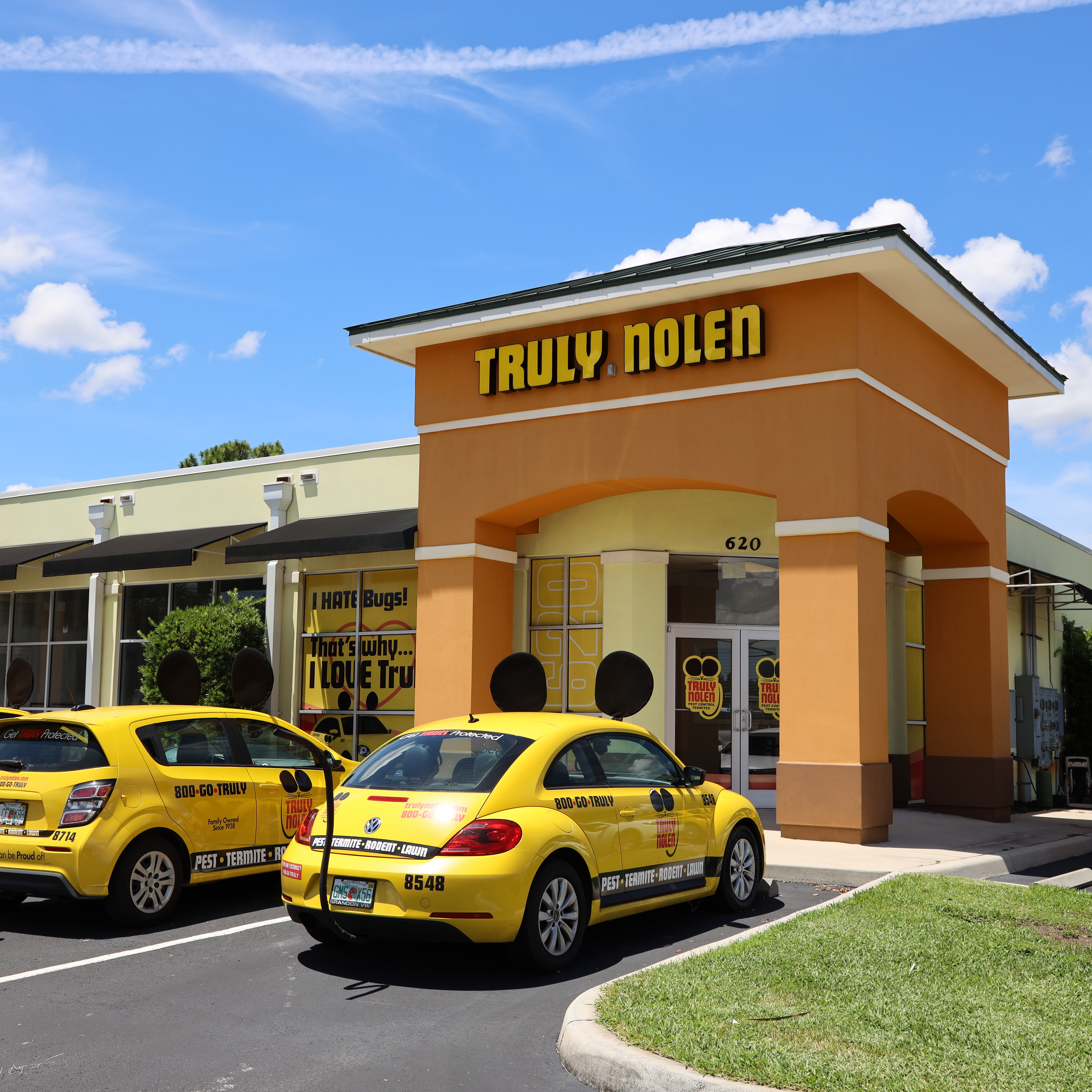
With nearly 100 locations nationwide, Truly Nolen has your pest control needs covered.